
Gold has always held a special place in Indian households. From weddings to festivals like Diwali and Akshaya Tritiya, Indians traditionally buy gold not just for emotional reasons but also as a store of value.
However, the way Indians invest in gold has evolved. Earlier, people mostly bought jewellery, coins, or bars. Today, investors increasingly prefer financial forms of gold such as Gold ETFs and Gold Mutual Funds. These options remove storage risks, improve transparency, and make investing easier.
But many investors still ask one important question:
Gold ETF or Gold Mutual Fund – which one is better?
The answer depends on your investment style, convenience, and financial goals. In this detailed guide, we will break down both options clearly so you can choose the right one for your portfolio.
Why Investors Include Gold in Their Portfolio
Before comparing Gold ETFs and Gold Mutual Funds, let’s understand why gold matters in investing.
Gold plays an important role in diversification. When stock markets fall or economic uncertainty rises, gold often performs well. That’s why many financial planners recommend allocating 5–10% of your portfolio to gold.
Here are the main reasons investors buy gold:
1. Portfolio Diversification
Gold usually moves differently from equities and debt instruments. When markets fall, gold often holds value or rises.
2. Hedge Against Inflation
Over long periods, gold protects purchasing power. As inflation rises, gold prices tend to increase.
3. Safe-Haven Asset
During economic crises or geopolitical uncertainty, investors rush toward gold.
4. Liquidity
Modern financial gold investments allow investors to buy or sell quickly.
Because of these benefits, many Indian investors include gold alongside investments like equities, debt funds, and fixed deposits.
What is a Gold ETF?
A Gold ETF (Exchange Traded Fund) is a mutual fund that invests in physical gold of 99.5% purity and trades on stock exchanges just like a share.
Asset management companies offer Gold ETFs listed on Indian stock exchanges like the National Stock Exchange of India and the BSE Limited.
Each unit of a Gold ETF represents approximately 1 gram of gold (or a fraction of it).
Key Features of Gold ETFs
- Traded on stock exchanges like shares
- Requires a Demat and trading account
- Tracks domestic gold prices
- High liquidity during market hours
- Transparent pricingGold ETFs closely follow gold prices because they invest directly in physical gold.
What is a Gold Mutual Fund?
A Gold Mutual Fund is an open-ended mutual fund that invests in Gold ETFs instead of physical gold directly.
In simple words:
Gold Mutual Fund → invests in → Gold ETF → invests in → Physical Gold.
Gold mutual funds belong to the Fund of Funds (FoF) category. Investors do not need a Demat account to invest in them.
Asset management companies regulated by the Securities and Exchange Board of India offer these funds.
Key Features of Gold Mutual Funds
- No Demat account required
- Investment possible through SIP
- Managed like a regular mutual fund
- Slightly higher expense ratio than ETFs
- Easy for beginners
For investors who prefer the mutual fund route, gold mutual funds offer a simple entry into gold investing.
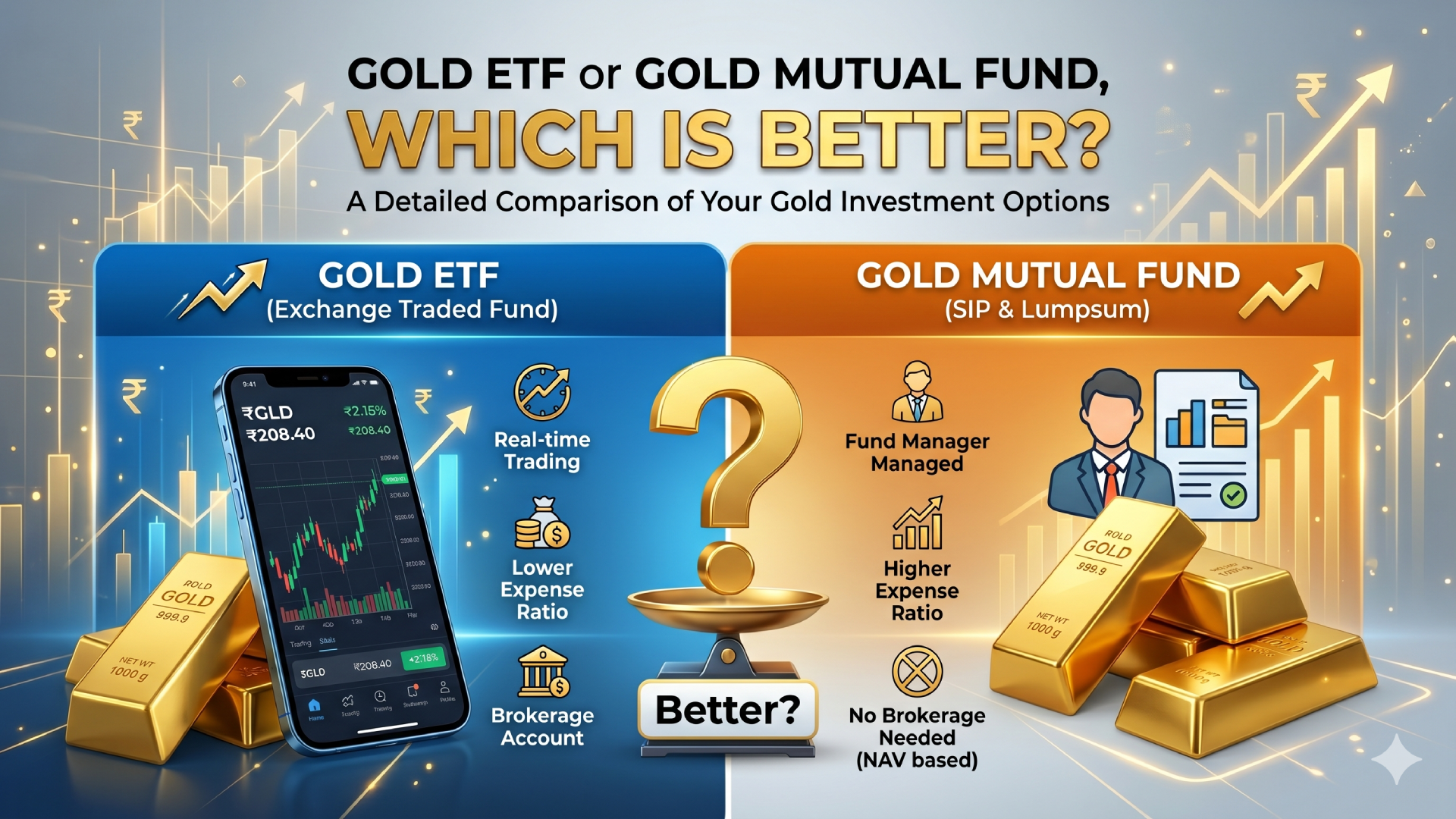
Gold ETF vs Gold Mutual Fund: Key Differences
Understanding the differences helps investors choose the right option.
1. Mode of Investment
Gold ETF
- Traded on stock exchanges
- Requires Demat and trading account
- Bought and sold like shares
Gold Mutual Fund
- Purchased directly from AMC or mutual fund platforms
- No Demat account required
For investors who already trade stocks, Gold ETFs work well. Beginners usually find Gold Mutual Funds easier.
2. Expense Ratio
Expense ratio refers to the annual fee charged by the fund.
Gold ETFs generally have lower expense ratios because they track gold prices passively.
Gold mutual funds include:
- ETF expense ratio
- Additional fund management costs
As a result, gold mutual funds usually cost slightly more.
Data published by the Association of Mutual Funds in India confirms that ETF expense ratios often remain lower than fund-of-funds structures.
3. Liquidity
Gold ETF
You can buy or sell ETFs anytime during stock market hours.
Gold Mutual Fund
Transactions occur only once per day based on Net Asset Value (NAV).
Active investors prefer ETFs because they allow intraday trading.
4. SIP Facility
Gold ETFs generally do not offer direct SIPs unless you use a broker’s platform.
Gold Mutual Funds allow Systematic Investment Plans (SIP) easily.
SIP helps investors average out gold prices over time.
5. Pricing Transparency
Gold ETFs offer real-time prices on exchanges.
Gold Mutual Funds provide end-of-day NAV.
If you want immediate price visibility, ETFs work better.
6. Minimum Investment
Gold ETFs require purchase of at least one unit, which depends on the current gold price.
Gold Mutual Funds allow very small investments, often starting from ₹500 through SIP.
This flexibility attracts many retail investors.
7. Demat Requirement
Gold ETFs require:
Demat account
Trading account
Gold Mutual Funds do not require Demat accounts.
Many first-time investors choose mutual funds for this reason.
Taxation of Gold ETFs and Gold Mutual Funds in India
Taxation rules for both instruments remain similar because both are treated as non-equity mutual funds.
According to current Indian tax rules:
Short-Term Capital Gains
If you sell within 3 years, gains are taxed according to your income tax slab.
Long-Term Capital Gains
If held for more than 3 years, gains are taxed at 20% with indexation benefit.
Tax laws change periodically, so investors should always confirm current rules through official government notifications.
Advantages of Gold ETFs
Gold ETFs offer several benefits for investors.
1. Lower Expense Ratio
Since ETFs directly track gold prices, they usually cost less than gold mutual funds.
2. High Transparency
Investors see real-time prices on exchanges.
3. No Storage Risk
Gold ETFs eliminate risks associated with storing physical gold.
4. High Purity
ETFs invest in gold of 99.5% purity, following standards set by regulators.
5. Easy Trading
Investors buy or sell units anytime during market hours.
For investors who already trade stocks, Gold ETFs provide a smooth experience.
Advantages of Gold Mutual Funds
Gold mutual funds also offer strong benefits.
1. No Demat Account Required
This feature makes them ideal for beginners.
2. SIP Investment
Investors can start systematic investments easily.
3. Simple Process
Investing works just like any other mutual fund.
4. Automatic Management
Fund managers handle the ETF investments inside the fund.
Many retail investors prefer this convenience.
Disadvantages of Gold ETFs
Despite their advantages, Gold ETFs also have limitations.
1. Demat Requirement
Investors must maintain a Demat account.
2. Brokerage Charges
Buying or selling ETFs may involve brokerage fees.
3. Market Liquidity
Some ETFs may have lower trading volumes, which affects price spreads.
Disadvantages of Gold Mutual Funds
Gold mutual funds also have a few drawbacks.
1. Higher Expense Ratio
The fund-of-funds structure adds extra cost.
2. No Intraday Trading
Investors cannot buy or sell during market hours.
3. Slight Tracking Difference
Because they invest in ETFs instead of gold directly, minor tracking differences may occur.
Gold ETF vs Gold Mutual Fund: Which is Better?
There is no single answer that suits everyone. The better option depends on your investment style.
Gold ETF May Be Better If:
- You already have a Demat account
- You actively trade in the stock market
- You want lower expense ratios
- You prefer real-time price tracking
Gold Mutual Fund May Be Better If:
- You do not have a Demat account
- You prefer SIP investing
- You want simplicity and convenience
- You invest through mutual fund platforms
Most long-term retail investors often choose gold mutual funds due to ease of use.
Summary:
Avoid Buying Gold Jewellery as an Investment
Many Indians buy jewellery believing it is an investment. In reality, jewellery includes:
- Making charges
- Wastage costs
- Design premiums
These costs reduce investment value.
Financial gold instruments like ETFs or gold mutual funds provide better transparency and liquidity.
Conclusion
Gold continues to play an important role in Indian investment portfolios.
Both options remove the problems associated with physical gold, such as storage risk and purity concerns.
The right choice ultimately depends on your investment style. Investors who prefer stock-market trading may choose Gold ETFs, while those who want convenience may prefer Gold Mutual Funds.
In most cases, a small allocation of 5–10% to gold helps improve portfolio stability and diversification.
If you have more queries and want plan your allocation and invest with discipline you can contact Kirit Nagda, founder ArthNivesh Financial Services, +91-9820818367.